𝙙𝙞𝙨𝗮𝗿𝗺𝗶𝗻𝗴 II performance
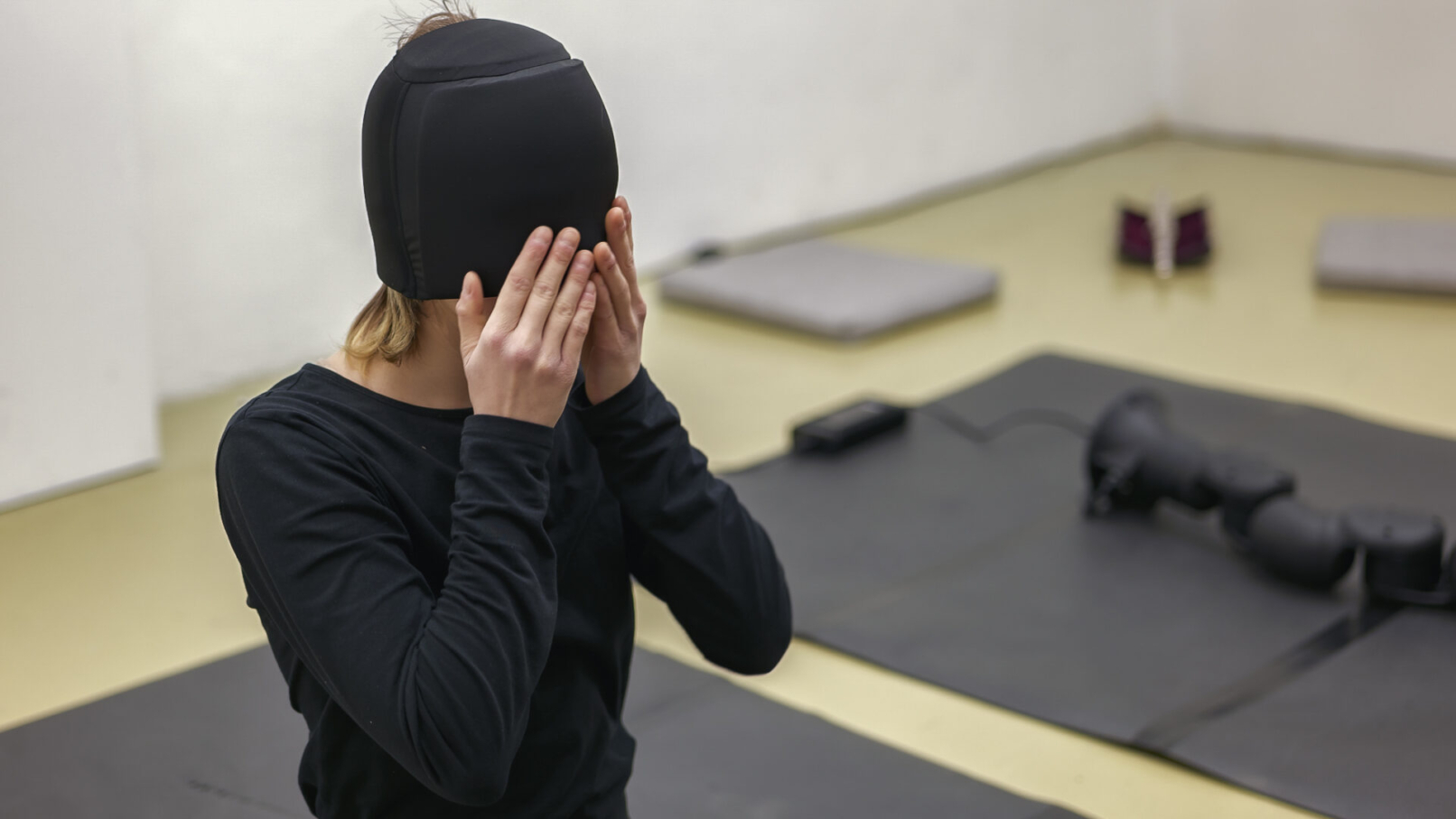
disarming II performance continues the disarming series with a 25-minute improvisational setting in which a dancer, a flautist, and a detached robotic arm meet without script or hierarchy.
Like in disarming, the robotic arm learns in real time, here however in a triadic setting that interweaves its learning process with human improvisation. Through stereophonic listening and torque feedback, the arm navigates a continuous tension between contact and resistance, exploring ways of moving forward in relation to the sound, friction, and presence of its co-performers.
Dasha Bogdan, a dancer experienced in Butoh, is attempting to place herself in the situation of the robot and bodily imagine how she would relearn her movements through acoustic and haptic attention alone. Mar Sala Romagosa, a flautist and sound artist, brings her experience in attunement and listening-based improvisation, acoustically mediating between the two bodies navigating the space.
What unfolds between them is not collaboration in the conventional sense. All three rely on sound and movement as primary modalities while bringing fundamentally different forms of body knowledge. The differences in temporality, sensory access, and intentionality are not resolved but become the generative material of the encounter. The setting is designed to stretch the learning and undermine its efficiency, opening a space to observe one’s own projections and the multiplicity of relationships emerging and transforming between the involved entities.
disarming II performance is part of the ongoing disarming series, which removes industrial robots from functional contexts and places them in performative situations. Instead of efficiency or servitude, the negotiation between radically different bodies becomes the subject.
WRO ART CENTER: For your residency, you’ve been working on a project named disarming. Tell me about it.
EMANUEL GOLLOB: disarming is a series of works exploring the relationship between a detached robotic arm, its artificial environment, and the human observer.
WRO ART CENTER: It is a machine that learns to locomote. How is that?
EMANUEL GOLLOB: I was intrigued to pick up the industry’s narrative of robots becoming more and more autonomous with the help of machine learning. Looking back in history, there has been a time when autonomy, or the ability to be self-moving, was explored as one definition of being alive. Today, we have very different definitions of aliveness, but we still have this tendency towards anthropomorphization. Thus in disarming, each format & iteration features a different constellation in which a detached robotic arm continuously tries to learn how to move forward.
WRO ART CENTER: What’s your role in that learning?
EMANUEL GOLLOB: My role in it is to create an open setting in which the learning is stretched and inefficient, creating a space to observe one’s own projections and the multiplicity of relationships emerging and transforming between oneself, the robotic arm, the environment, and potential human co-performers. The algorithm’s inherent goal orientation thus receives a performative embedding.
WRO ART CENTER: What kind of modalities of the work can we encounter?
EMANUEL GOLLOB: disarming II is experienceable in three formats:
In the performance format, the detached robotic arm is accompanied by two human performers. One bodily imagining themselves in the situation of the robot learning body movement from new, while a second human performer bringing in their individual musical knowledge on attunement as well as navigation of bodies & spaces. In this format, the robotic arm continuously learns & unlearns based on stereophonic listening and haptic feedback, exploring ways of moving forward in balance with the sound of friction & resistance.
In the installation format, a detached robotic arm is durationally learning locomotion on a gym mattress in relation to its embedded virtual concept of its machinic body and surrounding space. It is aiming for strategies to increase the distance from the starting point, resulting in glitches of virtual success and physical struggle, as well as vice versa.
In the video format, the RL algorithm, learning physical locomotions with the robotic body in the video footage of disarming I, now observes the likelihood of recent social media postings mentioning “robot” and “arm” in the same post. In reference to this, the algorithm continuously learns and unlearns how to narrate the video scenes to decrease this tendency.
WRO ART CENTER: The project seems to be ongoing.
EMANUEL GOLLOB: I believe in doing art in an open and iterative manner, inviting collaborators, institutions, and environments to continuously evolve and extend this project together. By doing so, in some iterations, hidden layers of the project are brought to attention, while in others, additional cross-discipline links are explored. Due to that, I was particularly excited to collaborate for the performance format of my disarming II series with Dasha Bogdan, a dancer experienced in Butoh & contact dance, and Mar Sala Romagosa, a sound artist & flute player with a particular interest in multidisciplinary performances. Collaboratively shaping a hierarchically balanced performance where the robotic arm, Dasha and Mar, largely rely on sound and movement main modalities while still bringing in their unique tacit knowledge was challenging but I am super happy with how our collaboration evolved. Observing Dasha bodily imagining how she would re-learn motions based only on acoustic & haptic feedback while Mar acoustically brings in her experience in attuning with instruments, improvisation based on listening as well as musical references on bodies navigating in space and vice versa, to me, truly added another angle to disarming.
WRO ART CENTER: As far as I understand, you are combining industrial engineering, artificial intelligence with performance and work of the audience. So how did it all start for you?
EMANUEL GOLLOB: During my integrated master’s study in Design Investigations at the University of Applied Arts Vienna, I started to focus on how our ability to do nothing is changing in parallel to digitalization. And I found it ironic that automation is luring us with the promise that with AI-driven robotics, we might have more free time as robots will be working for us, but at the same time, we are also scared that maybe suddenly, we will have nothing to do. That was my start to delve further into our performative relationship with technology.
Core team
Emanuel Gollob – research, concept & production
Daria Bogdan – dancer, performer
Mar Sala Romagosa – flutist, performer
Advice and support
The wonderful WRO ART Center team – curatorial and organizational support
Amir Bastan – real-time robot control
Magdalena May – scenography
Creative Robotics – robotic hardware support
Mira Boczniowicz (WRO Art Center) – video documentation
Hardware | igus ReBel | PC | Migraine Relief Cap | Paetzold Flute | Piccolo Flute | Transverse Flute
Software | Reinforcement Learning | vvvv gamma
Acknowledgments | This work was realised within the framework of a European Media Art Platform residency program at WRO Art Center with support from the Creative Europe Culture Programme of the European Union.
References excerpt
Barad, Karen. Meeting the Universe Halfway: Quantum Physics and the Entanglement of Matter and Meaning. Duke University Press Books; Second Printing edition (July 1, 2007)
Penny, Simon. Making Sense: Cognition, Computing, Art, and Embodiment. The MIT Press (2017)
Riskin, Jessica. Genesis Redux: Essays in the History and Philosophy of Artificial Life. University of Chicago Press (2007)
Slager, Henk. The Pleasure of Research. Hatje Cantz Verlag (2015)